
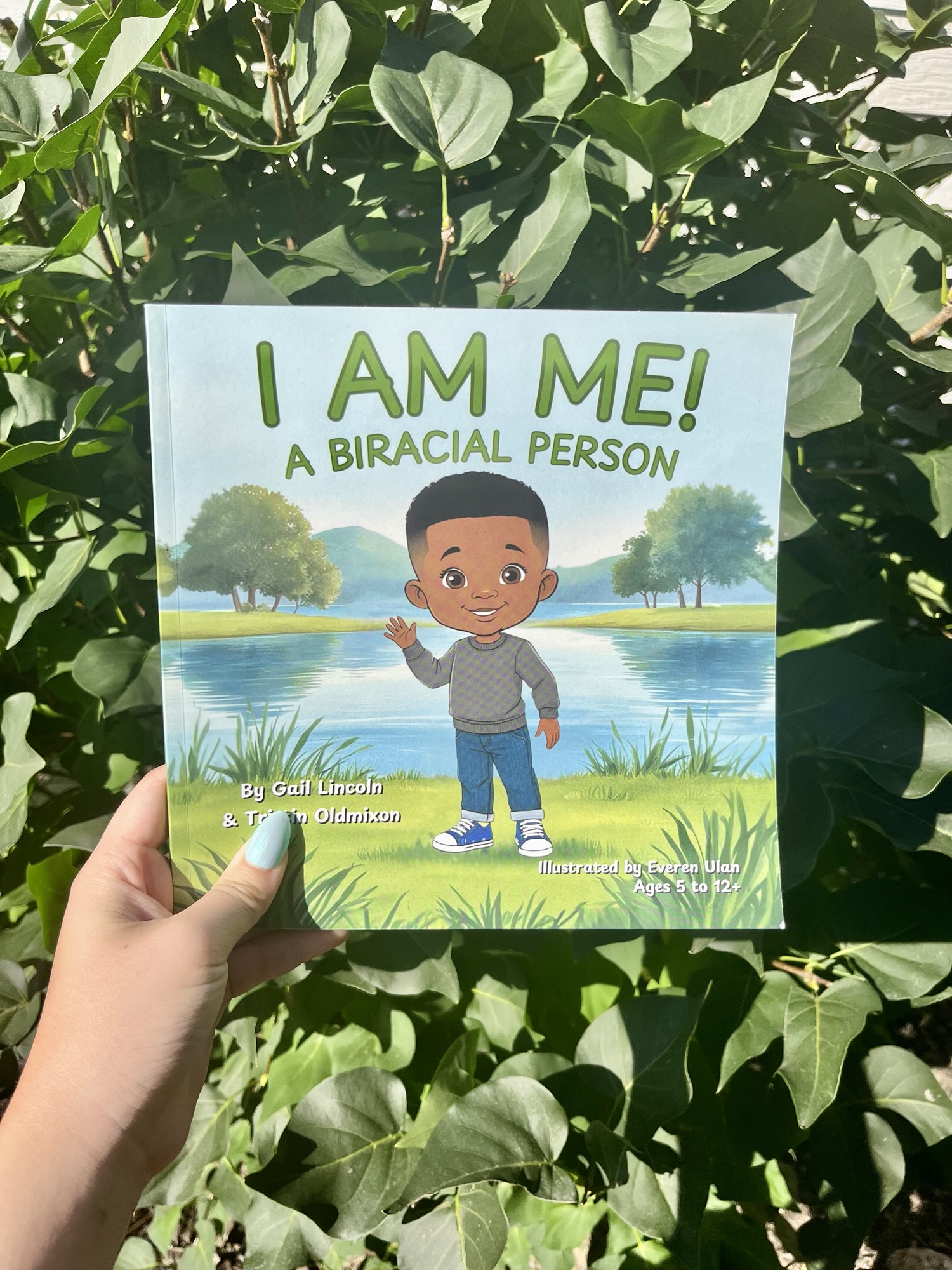
I had the absolute honor of getting to interview the co-authors of the children’s book I Am Me: A Biracial Person, Gail Lincoln and Tristan Oldmixon. Not only is the mother/son-in-law duo a powerful writing force, they are both amazing people that care about bringing conversations about color and intersectionality into the lives of our children. Please see below for their wonderful thoughts on perfecting the message for a young audience, focusing on kindness and love over hate, and their publishing journey.
Summary:
When retired teacher Gail and her son-in-law Tristan decided to write a children’s book together, they weren’t just creating another bedtime story. They were creating the book Gail’s former students, and Tristan’s younger self, needed to see in the world.
Living in Maine, Gail noticed the struggles biracial children faced in overwhelmingly white classrooms. She recalls a young boy tugging at his curls because no barber nearby knew how to cut Black hair, and a girl comparing her skin to Gail’s and asking, “Am I ugly?” Those moments stayed with her for a long time, eventually pushing her to write a children’s book on race.
Meanwhile, Tristan grew up biracial in Maine, not feeling comfortable in his own skin until his late twenties. “There wasn’t a lot of education around difference,” he explained. “My mom was doing her best as a single parent, but I had to learn confidence on my own.”
Together, they turned those experiences into I Am Me, a self-published children’s book that doesn’t shy away from real words like “discrimination” or “authenticity.” Yet the story radiates hope, centering on kindness, love, and respect.
“It could have focused only on the dark parts,” Tristan says. “But we wanted kids to see the light too—the friends who stick by you, the family that loves you, the joy of being yourself.”
Self-publishing has brought challenges, from finding an illustrator to navigating book festivals, but the response has been heartfelt.
Parents have praised the book for its honesty and its balance of realism with hope.
Both authors see I Am Me as part of a growing movement in children’s literature. One that embraces diversity, teaches empathy, and equips kids to be leaders and allies.
“We need more books that say it’s okay to be different,” Tristan reflects. “And not just that— it’s powerful.”
Q/A:
Q: What inspired you to write I Am Me?
Gail: Before I met Tristan, I was teaching in Maine, which isn’t a very diverse state. I would see children of color struggling with self-esteem. I’ll never forget a little boy constantly tugging at his curls because we didn’t have a barber who knew how to cut Black hair, or a little girl pressing her arm to mine and asking, “Am I ugly?” That broke my heart. I always wrote small books for my classroom, but I knew I wanted to create something bigger. When Tristan came into our family and shared his story, it all clicked—we worked together to make it authentic and real.
Tristan: For me, growing up biracial in Maine meant I didn’t always feel comfortable in my own skin. Honestly, it wasn’t until my late twenties that I truly felt that way. My mom was doing her best as a single parent, but there wasn’t a lot of cultural education in our community. The book was a chance to give kids the confidence I wish I had earlier—that it’s okay to be different, and that difference is beautiful.
Q: When did you know you had the message “just right”?
Gail: It came when Tristan and I sat down together to edit. He helped me with the vocabulary and details so that the story was authentic. Once we merged my perspective as a teacher with his lived experience, I knew we had something real.
Q: How did you balance introducing serious topics—like civil rights or discrimination—while keeping the book accessible for children?
Gail: That was the hardest part. I wanted the language to be real, not watered down, but still readable for kids. Words like “authenticity” or “discrimination” can feel big, but kids deserve honesty. With the help of friends and editors, I tried to keep the poetic tone while staying true to the message.
Tristan: I think she threaded the needle beautifully—it’s kid-friendly, but also introduces words kids will hear in the real world. Parents who’ve read it have said they love that it doesn’t shy away from tough language, but it’s still approachable.
Q: The book deals with identity, but it feels hopeful. Why focus on kindness and love?
Tristan: Because life has both dark and light moments. I’ve experienced the hard parts, but I also remember the love—friends who stood up for me as a kid, my Nana who always believed in me. We wanted the book to reflect that balance: yes, challenges exist, but love and support are powerful.
Gail: Exactly. We made a choice not to dwell on every painful story. Instead, we focused on respect, kindness, authenticity, and love.
Q: You self-published I Am Me. What was that journey like?
Gail: Honestly? Challenging. Finding the right illustrator was key because the pictures had to reflect Tristan authentically. Marketing is still tough—we’ve been to book festivals and events where sales were slow. But we’re determined.
Tristan: It’s about persistence and putting it in front of the right people. The response from individuals—friends, clients, parents—has been really encouraging.
Q: How do you see children’s literature evolving when it comes to biracial and multicultural representation?
Tristan: I’m hopeful. We’ve made progress, even though it sometimes feels like we take steps back. What I’d love to see more of are books that don’t just celebrate difference, but also teach kids how to be leaders and allies when someone else is treated unfairly.
Gail: At a recent book festival, I noticed very few books dealt directly with identity and diversity. That told me we need more of them. But I do think people are becoming more open to these conversations.
Leave a Reply