
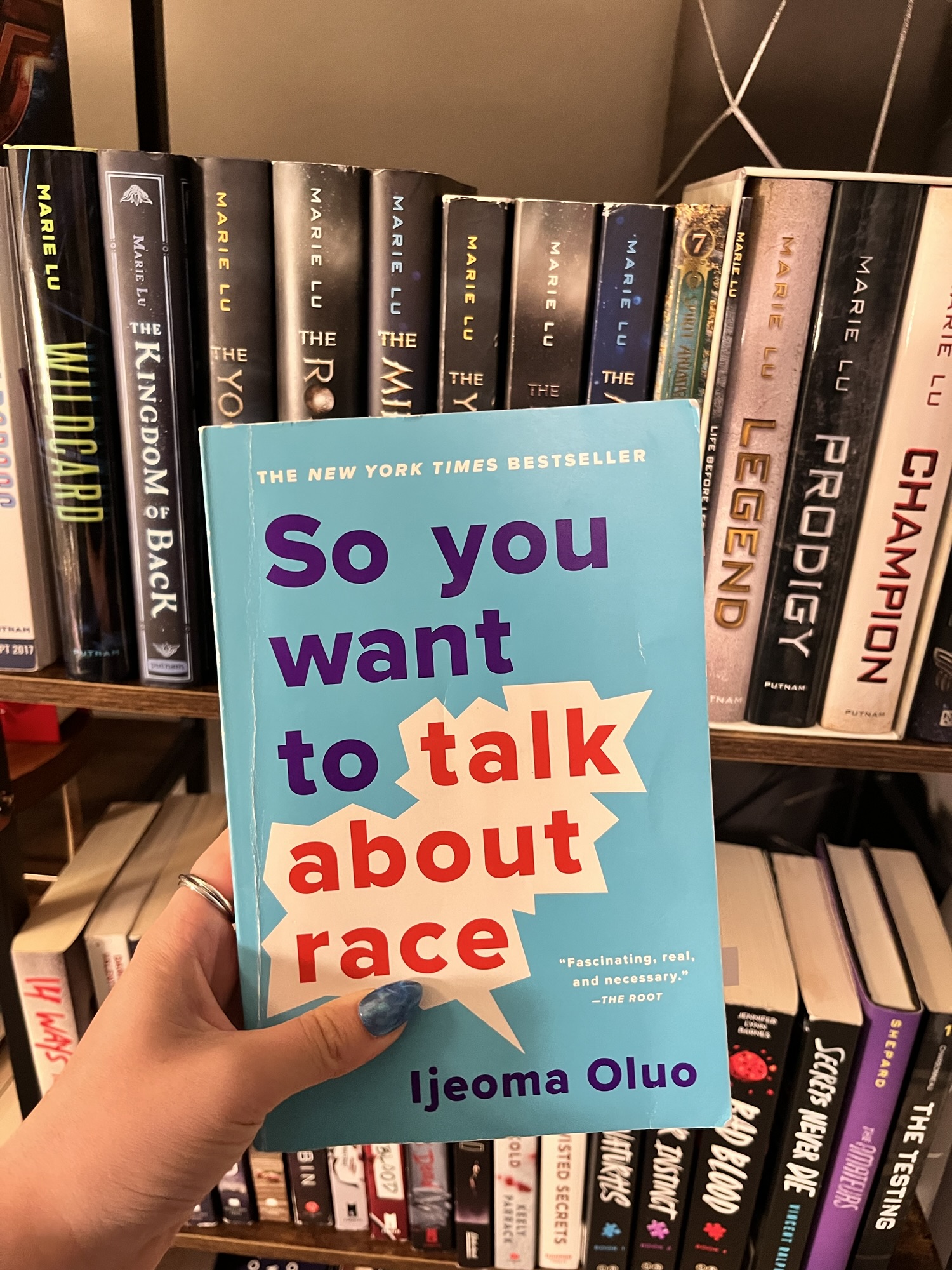
By Ijeoma Oluo
A deeply validating and moving read, So You Want to Talk About Race is essential for people of every race to read at least once in their lives. Ijeoma Oluo doesn’t shy away from the hard truths people need to hear. Flawlessly weaving her own experiences into real-world issues, she lays the foundation for how to respectfully talk about race so real progress and understanding can be reached.
Rating:
Review:
There are three reasons why this book resonated with me so deeply:
1. Oluo, a mixed-race Black and white woman, identifies solely as Black.
2. She validates the experiences of people of color through her explanations of microaggressions and more.
3. She directly acknowledges how Asians are often an afterthought in modern-day activism.
Each of these points struck me in a different way, shaping how I see myself and the conversations I have about race.
1. Identity and belonging
As a mixed-race individual myself, there’s always the struggle of identifying with a race that has also, at times, hurt you. There’s the challenge of identifying with a race when you will never have the same privileges as someone who is “technically” the same as you. Choosing to identify solely with one race is a hotly debated topic—but Oluo, an extremely notable figure in activism, identifies as a Black woman. Because she will never be viewed as anything other than Black, she decided she should also be able to view herself that way, not as “half.”
Seeing someone as prominent as her do this was incredible. It’s something that doesn’t always seem possible or “right,” yet Oluo showed it can be okay. And that is pretty special.
2. The power of microaggressions
Oluo makes it clear that microaggressions carry real weight, a weight that is often overlooked, thereby validating the experiences of people of color. While I wasn’t directly acknowledged in her examples as a mixed-race individual, I still deeply connected with the experiences she described.
Sure, she never explicitly said that mixed-race Asian women experience these same acts of racism, but I had. And simply acknowledging that these acts are racism is powerful. Too often, microaggressions are brushed off as “part of life” or written off as someone being “too sensitive.” But Oluo makes it clear this is not the case. That validation, even indirectly, can be one of the best tools for coping.
3. Naming the invisibility of AANHPI voices
Oluo directly acknowledges that the AANHPI community is often an afterthought in her work, and in activism more broadly. When she said this, I’ll admit, I started crying. No one had ever so clearly spoken the words I needed to hear.
For a long time, I’d wrestled with the feeling of being unseen in books on racism, conversations about racism, and activism against racism, not as an Asian individual, and certainly not as a mixed-race individual. To hear a leader in the activist community say this out loud… I can’t describe the feeling
Summary:
So You Want to Talk About Race isn’t just a book. It isn’t just a guide. It’s a key.
A key to connecting with others, no matter their race. A key to battling racism in your everyday life. A key to making a difference when change feels impossible.
For white readers, it’s a clear explanation of how to have these difficult conversations and how to recognize and stop racist acts you might not even know you’re committing.
For people of color, it’s a deeply validating work affirming that your experiences with race in America are real, and offering tools for how to respond when you face racism.
So no matter your race, go read So You Want to Talk About Race. Even if you don’t want to talk about race, you might need to. And this book will give you the tools to do it respectfully, for everyone involved.
Leave a Reply